Somewhere between “my kid has no way to reach me” and “my kid has a smartphone and the entire internet in their backpack,” there's a quieter option a lot of parents never hear about: a kids phone with no internet at all.
Not a locked-down smartphone with parental controls layered on top. Not a watch with a data plan. An actual phone that makes and receives calls — and does nothing else. If that sounds too simple to be useful, that's usually because we've forgotten the phone was ever meant to be simple in the first place.
Why “no internet” is a feature, not a limitation
When most parents shop for a first phone, they start by asking how they'll restrict it. Which apps to block. How to filter the browser. What screen-time limits to set. That framing quietly assumes the internet is coming into your home on that device, and your job is to fence it in.
A no-internet phone flips the question. There's no browser to filter, no app store to lock, no feed to time-limit, because none of it is there to begin with. The safety conversation shrinks from a dozen ongoing battles down to one simple decision: who is your child allowed to call?
You're not restricting the internet. You're choosing a device that was never built to carry it.
That difference matters more than it sounds. Parental controls fail, get outdated, or get worked around by a determined ten-year-old. A phone with no internet capability can't be “unlocked” into something it isn't.
What a kids phone with no internet actually solves
Before you buy any phone for a child, it helps to name the problem you're actually solving. For most families, it comes down to three things:
- Reaching each other. Your child can call you, and you can call them.
- Reaching people you trust. Grandparents, a best friend, the neighbor who does pickup on Thursdays.
- Peace of mind in a pinch. If plans change or something goes wrong, there's a way to make a call.
Notice what's not on that list: browsing, group chats, games, social media, or a camera roll. Those aren't needs — they're the extra cargo a smartphone drags along. A no-internet phone delivers the three things that matter and leaves the rest behind.
The hidden cost of “just a smartphone with limits”
It's tempting to hand down an old smartphone and promise yourself you'll manage it. In practice, that decision rarely stays small:
- Every app and update becomes a negotiation.
- Screen-time settings turn into a nightly standoff.
- Your child learns to associate “phone” with “endless scroll” from day one.
- You become tech support for a device designed to hold attention, not release it.
None of that is a moral failing — it's just what happens when the tool is built to keep someone engaged. A phone with no internet doesn't ask you to win that fight every evening, because the fight was never installed.
What to look for before you buy
If you decide a call-only phone is right for your family, here's a short checklist to compare your options:
1. Genuinely no internet — not just “hidden”
Some “kids phones” are Android devices with the browser tucked away. Look for a device with no web access by design, so there's nothing to uncover later.
2. Parent-approved contacts
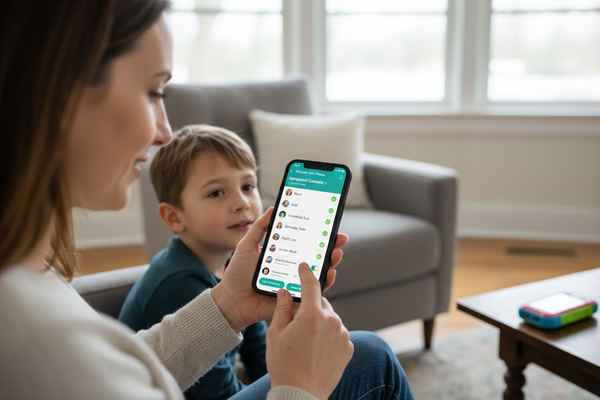
The best versions let you decide who's on the contact list, so your child can call the people you trust and no one else. That's the entire safety model, and it should be simple to manage.
3. A real path to emergency help
“No internet” shouldn't mean “no safety net.” The right phone still lets a child reach 911, and the best ones alert you the moment it happens.
4. Easy enough for a child to use alone
A young kid shouldn't need a tutorial. Big, obvious ways to call the people they know beat a menu of settings every time.
5. No cell plan to babysit
A phone that runs over your home WiFi skips the SIM card and the carrier contract, so there's no cellular plan and no surprise data charges to manage.
Where the family phone fits
There's also a middle path worth knowing about: a home phone that lives in one place rather than a device that lives in a pocket. A phone mounted in the kitchen means your child can call a friend to set up a playdate or reach Grandma after school — but it doesn't come to the dinner table, ride along to a friend's house, or disappear into a bedroom at night.
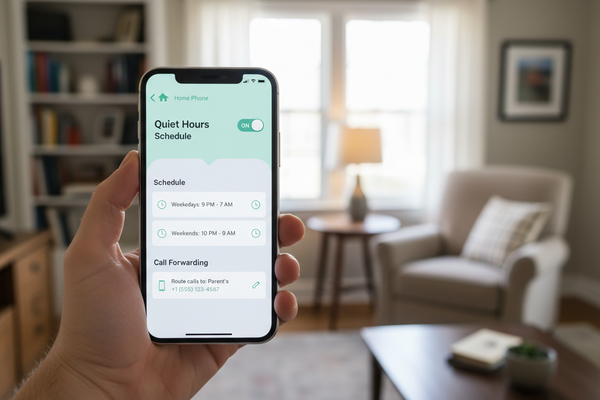
That's the idea behind the Tribe Phone: a WiFi home phone made for families and managed by you. Your child calls the contacts you approve — and only those, since everyone else is automatically blocked — over your home WiFi, with no cell plan and no internet, apps, or feed. You manage the contact list and set quiet hours for homework or bedtime from an app on your own phone, and 911 always goes through no matter what, with an alert to you and your emergency contacts if it's ever dialed. It sets up in about five minutes and costs $99 plus $9.95 a month, with no contract.
Whatever you choose, the takeaway is the same. Separate the need — staying reachable — from the bundle of everything else a smartphone carries. Once you do, a kids phone with no internet stops looking like a compromise and starts looking like the obvious first phone.
Still weighing whether your child is ready at all? Read Should a 12-year-old have a phone? next.